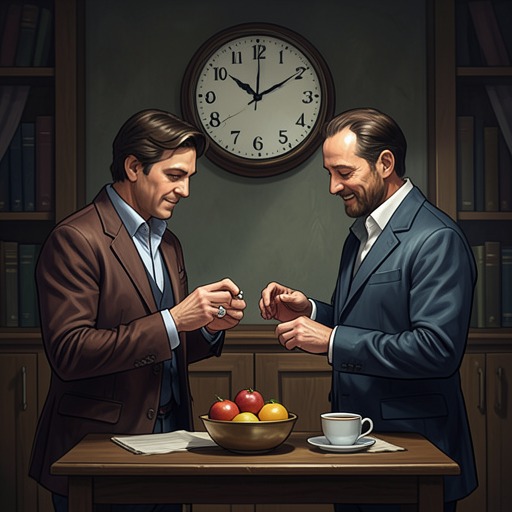
Commitment beyond marriage labels
After Ever HappyCommitment beyond marriage labels is the tension between Tessa and Hardin Scott’s enduring partnership and their unresolved decision to marry. Tessa wants to be Hardin Scott’s wife, yet no longer believes she needs the formal label in the way she once did. Hardin Scott, by contrast, is eager for a date. Their disagreement does not amount to a lack of commitment: they make a long-distance relationship work, build a shared home, and remain close even as the wedding question keeps resurfacing.
Meaning and Stakes
Tessa’s position holds two ideas together rather than choosing between them. She does want to be Hardin Scott’s wife, but she is tired of having to label their relationship. The distinction matters: her uncertainty concerns what marriage’s name should mean in her life, not whether she loves Hardin Scott or imagines a future with him. She has outgrown the belief she was raised with that she needed that label, while retaining the desire to marry him.
Hardin Scott’s impatience makes the difference between them visible. Their unmarried status drives him nearly to distraction, and he joins Tessa’s mother in asking whether they have chosen a date. The same question therefore carries different weight for each partner: to Hardin Scott, a date is an answer he wants; for Tessa, the repeated demand risks turning a personal decision into an obligation to settle the matter on someone else’s timetable.
A Partnership Sustained Across Distance
The couple’s life together is preceded by a period apart. After Tessa moves to New York City with Landon, she needs distance from Hardin Scott. They nevertheless keep seeing one another, with both describing the arrangement as casual despite its limits. Neither pressures the other to relocate: Hardin Scott does not demand that Tessa move to Chicago, and she does not beg him to move to New York City.
They maintain the relationship through visits, which Hardin Scott makes more often. Tessa suspects that his sudden work trips to the city are not simply about work, but the visits make her happy; when he leaves, she wants him to stay. That pattern gives the relationship a concrete form during their separation: distance is real, but so are the repeated journeys toward one another and Tessa’s desire for his presence.
About a year after Landon’s wedding, Hardin Scott finally moves to New York City. Their apartment in Brooklyn is decent, and, although Hardin Scott is earning a great deal of money, he agrees to live somewhere Tessa can help pay for. Her contribution matters to the arrangement: their home is not simply a place provided by the wealthier partner. Tessa works at a restaurant between wedding-planning work and classes, while Hardin Scott complains only minimally about her busy schedule. The details show a partnership organized around accommodation and shared practical life, not just an eventual wedding.
The Wedding Question at Home
Marriage becomes a family preoccupation during a visit from Tessa’s mother, David, and his daughter. Tessa loves having them visit, but her mother’s new focus on the couple’s lack of a wedding date irritates her. By that point in the week, her mother has asked about a date for the third time. The repeated question turns what might be a private uncertainty into a subject Tessa is expected to answer in front of relatives.
The exchange begins in the bathroom, where Tessa’s mother leans in to adjust her necklace. Tessa tolerates her mother grooming her and has even let her choose the jewelry that morning, but warns her not to pursue the wedding question. The contrast is pointed: Tessa allows affection and assistance in the small rituals of getting ready, yet draws a boundary when that closeness becomes pressure to set a date. Her objection is not to her mother’s presence but to the assumption that the decision is open for repeated family discussion.
That boundary softens into amusement when Tessa follows her mother out and finds Hardin Scott against the wall, tying his long hair into a bun. Tessa likes his hair long and laughs at her mother’s visible distaste for the bun. The domestic moment does not resolve the disagreement, but it places the wedding debate inside an affectionate, ordinary scene rather than a rupture between the couple. Hardin Scott puts an arm around Tessa’s waist and buries his face in her neck while her mother explains that she has been asking whether they have picked a potential date.
Hardin Scott responds that he wishes he could give her an answer, then attributes the delay to Tessa’s stubbornness. Tessa is annoyed that he and her mother are joining forces, even as she takes some pride in their alliance. Her mother agrees that Tessa is stubborn and blames her for inheriting the trait. The exchange makes the pressure communal, but its playful tone also shows the intimacy between the three of them; Tessa is not isolated in a confrontation, even when she feels outnumbered.
A Decision Left Open
David interrupts the growing consensus by reminding them that Tessa has only just graduated from college and asking them to give her time. Tessa smiles gratefully at him. His defense does not determine whether or when the couple will marry; it restores room for Tessa to make that choice without answering the question immediately. His gentleness toward Tessa’s mother, including taking her hand and kissing it, also keeps the intervention from becoming a hostile rebuke.
The episode leaves the couple unmarried and the date unsettled. That unresolved ending is central to the idea of commitment beyond marriage labels: the relationship is already expressed through visits, relocation, a jointly affordable apartment, and day-to-day accommodation, while marriage remains desired by Tessa but not yet scheduled. The narrative neither treats the label as meaningless nor makes it the sole proof of devotion. Instead, it allows the mismatch to remain visible: Hardin Scott wants an answer, Tessa resists being hurried, and their shared life continues without the decision being settled.